
Master the Digital SAT
Open Doors to the World's Top Universities
As elite institutions, including Harvard, Yale, and MIT, reinstate standardized testing requirements, your SAT score is once again one of the most powerful tools in your application.
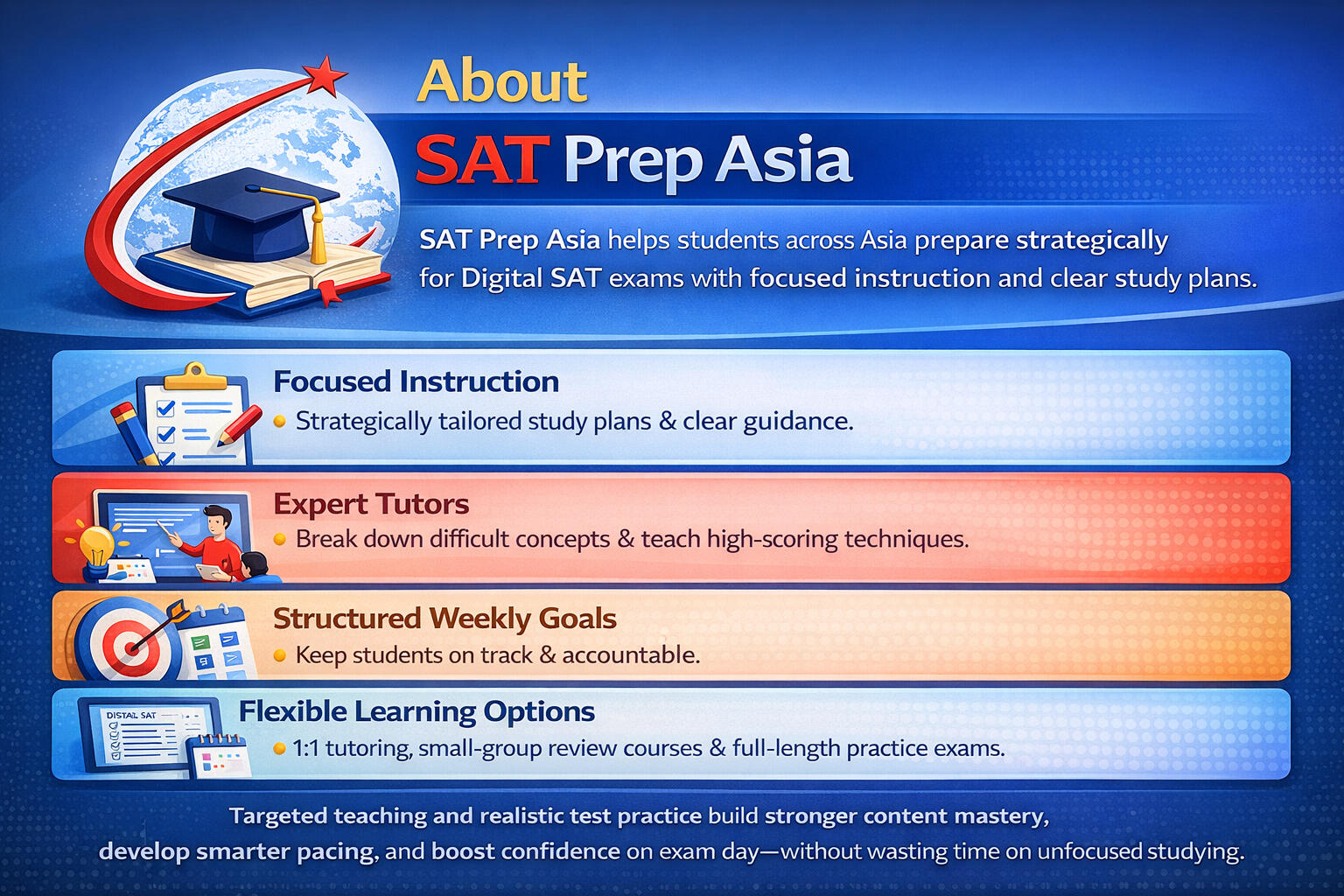
About
SAT Prep Asia
SAT Prep Asia helps students across Asia prepare strategically for Digital SAT exams with focused instruction and clear study plans. Our expert tutors break down difficult concepts, teach high-scoring exam techniques, and keep students on track with structured weekly goals. Whether you need 1:1 tutoring, a small-group review course, or full-length practice exams, we combine targeted teaching with realistic test practice and detailed feedback. The result is stronger content mastery, smarter pacing, and more confidence on exam day—without wasting time on unfocused studying.
SERVICES

1:1 SAT Tutoring
Personalized lessons targeting your weak areas, with a custom study plan and score-focused strategies.

Small-Group Review Class
High-impact review sessions with peers, covering key units, common question types, and timing techniques.

Full-Length Practice Exams & Feedback
Realistic timed SAT exams with detailed scoring breakdowns and actionable feedback to improve fast.
Not sure where to start?
Take a Mini SAT Diagnostic Test!
Take a short diagnostic test and receive immediate insights into your key areas for improvement — all in just 35 minutes.
AP Prep Asia
Powered by Trinity Scholar
What is Digital SAT?
The SAT is a standardized college admissions exam used by universities across the United States and recognized worldwide. It measures the essential reading, writing, and math skills developed in high school, the same skills that predict college and career success.As of 2024, the SAT is fully digital worldwide. The Digital SAT is shorter, more focused, and uses adaptive testing technology, making strategic preparation more important than ever.
At a Glance
| Feature | Details |
|---|---|
| Total Time | ~2 hours 14 minutes |
| Sections | Reading & Writing / Math |
| Format | Computer-adaptive (multistage) |
| Score Range | 400–1600 |
| Score Release | ~2 weeks after the test |
| Calculator | Permitted throughout the entire Math section |
| Test Setting | Authorized test centers only (no at-home testing) |
| No Guessing Penalty | Always answer every question |
International Test Dates 8 testing windows per year:
March, May, June, August, September, October, November, and December.**Official Dates & Deadlines: [Updated on April 10, 2026]
May 2, 2026
June 6, 2026
August 22, 2026
September 12, 2026
October 3, 2026
November 7, 2026
December 5, 2026
March 6, 2027
May 1, 2027
June 5, 2027
Reading & Writing Section
The Digital SAT replaces long reading passages with short texts of 25–150 words, each paired with exactly one question. Questions are grouped by skill and sequenced from easiest to hardest.
Four Skill Domains:
Information & Ideas — Comprehension, data graphics, and main idea analysis
Craft & Structure — Vocabulary in context and author's purpose
Expression of Ideas — Revising and improving written expression
Standard English Conventions — Grammar, punctuation, and sentence structure
Math Section
The Math section emphasizes practical application and real-world problem solving, with full calculator access throughout.
| Domain | Questions | Focus Areas |
|---|---|---|
| Algebra | 13–15 | Linear equations, systems, inequalities |
| Advanced Math | 13–15 | Quadratics, exponents, nonlinear functions |
| Data Analysis | 5–7 | Ratios, percentages, data interpretation |
| Geometry & Trigonometry | 5–7 | Area, volume, trigonometric functions |
What About the PSAT?
The PSAT (Preliminary SAT) is the official practice version of the SAT, administered to students in grades 8–11. It follows the same digital, adaptive format as the SAT and is one of the most valuable steps a student can take before sitting for the real exam.
Why the PSAT Matters:
Serves as a realistic, full-length rehearsal for the SAT
Helps identify strengths and knowledge gaps early
Provides diagnostic data to guide your SAT prep plan
Outstanding scores increase your visibility to universities, which may proactively invite you to apply
Qualifies U.S. citizens/permanent residents for National Merit Scholarship consideration
Key PSAT Facts:
Same adaptive format as the Digital SAT — shorter passages, one question per passage, full calculator access in Math
Scores released approximately 4–6 weeks after the test date
PSAT scores are not automatically shared with universities; they are primarily for student and parent reference
You do not need to take the PSAT 8/9 or PSAT 10 first — 11th graders can register directly for the PSAT/NMSQT
⚠️ Registration Note: Unlike the SAT, students cannot register for the PSAT individually. Registration must go through a school or an authorized testing center.
Trinity Scholar assists students with PSAT registration — contact us for details.
Concentrate on your prep, and let us handle the rest!
Sign up with us now!
AP Prep Asia
Powered by Trinity Scholar
Why it Matters?
Your SAT Score Is Your Global Academic Credential
The SAT is more than a test — it is one of the most recognized indicators of academic readiness in the world. Here is why it belongs at the center of your college planning strategy.
Top Universities Are Requiring It Again — After a period of test-optional policies, elite institutions including Harvard, Yale, and MIT have reinstated standardized testing requirements. A strong SAT score is once again a decisive factor at the most competitive schools.
It Strengthens Every Application — Even at test-optional schools, submitting a strong SAT score adds credibility to your application. Admissions officers use it alongside GPA, transcripts, recommendations, and essays to build a complete picture of your academic readiness.
It Opens Scholarship Opportunities— SAT scores create a direct pathway to merit-based scholarship consideration. A high score can significantly expand your financial aid options.
Score Benchmarks
| Percentile | SAT Score |
|---|---|
| Top 1% | 1510+ |
| Top 25% | 1210+ |
| Top 50% | 1080+ |
What counts as a "good" score depends on your target schools. Research the average accepted student scores at each university on your list.
Section scores Matter Too
Colleges often evaluate individual section scores based on your intended major.
A strong Math score carries extra weight for engineering applicants; Reading & Writing matters more for humanities programs.
Test-Optional vs. Test-Blind — Know the Difference
Test-Optional: You choose whether to submit scores. A strong score adds value; a weak score can be withheld.
Test-Blind: The school does not consider scores at all, even if submitted.
Always research the specific policy of each school on your list.
Concentrate on your prep, and let us handle the rest!
Sign up with us now!
AP Prep Asia
Powered by Trinity Scholar
How to Strategically Prepare for your SAT?
Prepare Smarter, Not Just Harder
When to Start?
The ideal time to begin SAT preparation is the summer before 11th grade, with the goal of reaching your target score by the end of junior year. This keeps 12th grade free for college essays and application work — one of the most common planning mistakes students make is leaving SAT prep too late.For students in earlier grades, the PSAT is the perfect starting point: it builds familiarity with the format and produces diagnostic data that shapes a more targeted SAT prep plan.
How Many Times Should You Test?
While the SAT has no official attempt limit, we strongly recommend sitting for the exam no more than three times:
Prepare first, then test — Only register for the real exam once you are consistently hitting your target score in practice tests.
Diminishing returns — Score improvements typically plateau after the third attempt.
Admissions perception — Excessive attempts can raise questions about a student's learning efficiency. Most schools that see all scores will notice the pattern.
Many colleges allow "Superscoring" — combining your highest section scores across multiple test dates into one composite. Check each school's policy to plan your attempts strategically.
Score Improvement: Reading & Writing
Read regularly in English — Magazines, news articles, academic journals, and short stories all build the reading speed and comprehension the SAT rewards.
Practice under timed conditions— Time pressure is one of the biggest hurdles for non-native English speakers. Timed mock tests build pacing instincts.
Analyze every error — After each practice test, identify whether a wrong answer was a careless mistake or a knowledge gap — then target that specific skill.
Score Improvement: Math
Take full-length practice tests frequently — Volume builds intuition for question types and pacing.
Identify weak areas precisely — Whether it's trigonometry, quadratics, or data interpretation — find the gap and fill it.
Re-solve before reviewing — Attempt missed questions again before reading the explanation. Active recall strengthens retention far more than passive review.
Master Desmos — The built-in graphing calculator in the Bluebook app is extremely powerful. Students who are comfortable with it gain a significant time advantage.
| Stage | Strategy |
|---|---|
| The night before | Review past errors, avoid new material, sleep well |
| Morning of | Eat a high-protein breakfast; arrive early |
| During the test | Don't get stuck — move on and return; use answer elimination; never leave a blank |
| After each section | Reset mentally; each module is a fresh start |
Concentrate on your prep, and let us handle the rest!
Sign up with us now!
AP Prep Asia
Powered by Trinity Scholar
FAQ
SAT Frequently Asked Questions
1. Is the SAT now fully digital?
Yes. As of 2024, the SAT is fully digital worldwide. It uses a computer-adaptive format where the difficulty of the second module adjusts based on your performance in the first.2. Is the Digital SAT easier than the old paper version?
Not necessarily. While the shorter duration and concise passages reduce fatigue, the adaptive format means every question carries more weight. Reaching the harder second module is essential for achieving top scores.3. Should I take the SAT or the ACT?
Universities accept both equally. We recommend taking a full-length diagnostic test for each — the SAT is more logic-based, while the ACT is more speed-based. Your natural strengths should guide the choice.4. Do colleges see all my SAT scores?
Most schools let you choose which scores to send, and many use Superscoring (combining your best section scores across dates). However, some schools require all scores. Always verify the policy for each school on your list.5. What is a Superscore?
Superscoring means a college takes your highest section score from each test date and combines them into one composite. For example, if you scored higher on Math in October and higher on Reading & Writing in March, the Superscore uses both bests.6. Can a high SAT score make up for a low GPA?
It can serve as a mitigating factor by demonstrating academic potential, but it cannot fully replace a consistently strong GPA. Think of it this way: GPA reflects long-term commitment; the SAT provides a standardized snapshot of ability.7. Can I use my own calculator on the Digital SAT?
Yes — you may bring your own approved physical calculator or use the built-in Desmos graphing calculator in the Bluebook app. We recommend becoming proficient with Desmos before test day.8. What are "Student Notes" questions?
This is a unique Digital SAT question type. You are given 5–7 bullet points about a research topic and asked to select an answer that achieves a specific goal (e.g., "contrast two findings"). It tests logical synthesis — not memorization.9. What is the PSAT and should I take it?
The PSAT is a digital, adaptive practice version of the SAT. It is highly recommended for students in grades 9–11 as a low-stakes way to experience the real test format, identify gaps early, and build a data-driven SAT prep plan. [Learn more → What is the SAT? / PSAT section]10. Can international students benefit from the PSAT?
Yes. While the National Merit Scholarship is limited to U.S. citizens, the PSAT still gives international students a realistic SAT rehearsal and can increase university visibility during the admissions process.
AP Prep Asia
Powered by Trinity Scholar
Ready to Start?
Let's Build Your Plan.
Whether you are mapping out a multi-year strategy starting with the PSAT, or you need focused prep before your next SAT test date, Trinity Scholar team is here to help through SAT Prep Asia.
What We Offer:
Personalized study plans built around your diagnostic results
Expert instructors with deep knowledge of the Digital SAT's adaptive format
Full-length mock exams that replicate the official Bluebook testing environment
Performance analytics across all four content domains
Not sure where to start?
Take a Mini SAT Diagnostic Test!
Take a short diagnostic test and receive immediate insights into your key areas for improvement — all in just 35 minutes.
Contact us
Call: +886-2-2771-6002
Email: [email protected]
Line: @TrinityScholar
AP Prep Asia
Powered by Trinity Scholar